


No Ocean for Young Women. A story of learning to surf from Andrea Female Surf instructor

Updated: Mar 11, 2022
🌊To survive a long career as a woman in tech, you may want to pick up surfing. I don’t say this facetiously or as an experienced surfer trying to get others to join the sport, but as someone who didn’t stand up on a surfboard until I was thirty, when I had already worked in tech for nearly a decade. Living in Silicon Valley, I’d done the usual and unusual things—justified a torturous 3hour commute, picked up a taste for ceviche and complex red wines, vacationed horseback across the Wadi Rum in Jordan—and returned to work to confront that question nearly every woman in tech has asked herself, “Is this the life I want to live?”
🌊To be honest, I’ve had an easier time than most. For years, that left me blind to what others faced, and quite ignorant of the neardaily scandals now breaking in the news. Having gone to an Ivyleague engineering school on a scholarship, I am guilty of carrying at some point or another in my career each of the various misconceptions about why there are so few women in tech. They must not be interested, they don’t have the skills, they just prefer to work with people rather than be behind a screen, they leave the industry of their own volition to raise children, always they, where other women’s experiences were different from mine.

🌊Our minds play tricks on us, and there is no question that it helped me to distance myself from the struggles of others. I was also the product of a dysfunctionally competitive education system that taught me to excel in testtaking environments like interviews and to see my success as the deserved fruit of my labor, and others’ failure as a character flaw. Teachers would tell us that nobody was stupid, but some people were lazy, undisciplined. I never thought to question that assessment, even though I myself was quite lazy and undisciplined. The truth is, if my parents hadn’t done what so many Indian parents do, stepping in as educators where teachers had failed, pushing me out of my comfort zone, protecting me from all housework and distractions and forcing me to take my studies seriously, all while saving up every dime, I probably wouldn’t have made it to college at all.
🌊I also have no excuses for being the wellintentioned but terrible manager who tried for years to help people follow my career path instead of helping them through theirs. I remember being puzzled at why my hardwon wisdom, about having a growth mindset about setbacks, leading with optimism, and building the temperament to manage ambiguity, only served to piss off the next generation of women joining tech. Such wisdom is a luxury you can’t afford when you feel you’re treading water in a rip current and a mile from dry land.
Then, what you may need is a surfboard.
🌊My first surf lesson was at Pacifica. It was a miserable day, cold with a fog that seeped through to chill the bone. I was with two of my friends, colleagues who had bought a group lesson.

The ocean was choppy, with high winds that created an incessant swirl of seething foam that felt like a thousand shards of glass. I still remember standing on that stony beach in a rental wetsuit that was damp and reeked of the ocean, being glad of the cowl around my head and my booties. I couldn’t feel my toes, and I remember thinking, my grandmother couldn’t even look at Niagara Falls, and I’m trying to surf in the Pacific ocean. It felt momentous in that way that things do in your twenties.
🌊 “Why are you still standing there?” one of my friends called out to me as he raced into the water. “The longer you wait, the colder you’ll get.”
🌊He didn’t understand that my fear was nearly as deep as the ocean before me. It went back centuries to a peninsula that had remained isolated from the world so that even our gods
🌊did not swim, but waited for an army of monkeys to build them a bridge to nearby Lanka. In our mythology, otherwise invincible warriors fell into water and were immediately at risk of drowning unless they were rescued by willing waternymphs who fell in love with them. In the city where I was born, Chennai, a tsunami had ravaged miles of coastline. My fear wasn’t the very rational fear of drowning that can be managed with some good swimming lessons. What struck me when I looked at the Pacific, what still overcomes me when I watch the waves dash themselves against the rocks of PrincetonbytheSea, Montara, or Mendocino, is the terror and soulsearing awe that one might feel in the presence of a god.
🌊I didn’t stand up on my board that day, although I pushed myself to stand in the water for a little while and tried the popup motions I saw others doing. Nobody bothered to put me out of my misery by telling me that you can’t really stand on your board unless it’s moving, any more than you can balance on your bike when it’s stationary. I lied that I’d had fun but was glad to get out of the damp and back to my citylife, until the next time another set of guys invited me surfing. It didn’t strike me as strange at the time. Gender ratios and working hours in the tech industry meant that most of my colleagues were men, and many of my colleagues were my friends. It also didn’t seem strange that I would go back over and over when I wasn’t really having fun. I had done a lot of competitive sports growing up, so I knew that you only really started having fun when you had acquired some skill, and I knew the only way to get skilled was to practice.
🌊I took lessons again in Pacifica with my friend Sarah, and in Santa Cruz and in San Diego, wondering why everyone else was able to do things I simply couldn’t do. Lift your chest up, they said. My chest was up, but the chest of an Indian woman is usually different from that of a Caucasian girl, and I guess the surf instructors were either unaware or too embarrassed to explain that I would have to work twice as hard to peel myself off the board. Keep paddling, I was told.
🌊It gets easier once you’re past the waves. But that point of stillness in the ocean, the lineup where surfers perched to watch the horizon for the next big wave, might as well have been in Hawaii. I paddled until I was panting for breath, until my arms were sore, until a large splash of whitewater knocked me off my board and I thought I was going to drown, only to find that the water was only neckdeep and I had barely made it fifteen feet from the shore.
🌊Eventually, I gave up. I became the project manager for surf trips, the person who drove others to beautiful vistas, watched over their valuables and photographed their moments of triumph, ensured that they got out of the water in time for dinner and, on at least one occasion, drove a boyfriend with a broken collarbone to the hospital. But I stayed out of the water. I read and wrote books instead, and the more I saw of the surfing scene the happier I was with my choices. The harddrinking, potsmoking beachbum stereotype has given way over the last decade or so to a leaner, more focused kind of masculinity, that of the nerdjocks who can just as easily explain the physics of wind currents and wave patterns as they can ride them, and who have enough money to invest in new surfboard companies, never mind buy the latest, shortest board on the market and hire a personal coach.
🌊In Southern California, the surfing scene did include several women with perfect arched backs and waistlength hair the color of the sand. If you were dating someone who surfed, you had to surf. One woman told me that her boyfriend simply took her to the lineup and left her there, day after day, for an entire month, expecting that she would learn by watching him.
🌊It was only when a female friend noticed this that she gave the girl lessons and pulled her away to the beginner beach. But in Northern California, on that colder, more treacherous coastline between San Francisco and Santa Cruz, there were probably more great white sharks than there were women. It wasn’t as if there were no women in the water. One of them, my former colleague Minnie, would charge the waves with her broad forehead completely serene, a tall Nordic goddess who belonged in the ocean and seemed equally at ease running her tech startup as she did when she hit the waves. I watched with awe, but I didn’t feel equal to asking her to help me out, any more than I would coldcall my favorite authors and ask them to help me become a better writer.
I didn’t feel that I was missing very much. In California, there are no seasons, but when the traffic on the 101 slows to a halt with rain, there is a quickening of the heart that can be felt across the valley because it means there is snow in Tahoe. The scent of bay leaf and the promise of fresh berries fills the mountains of Marin, where I would ride horseback, ending my weekends with a canter through the beach. When my commute from San Francisco to the South Bay started to take over three hours a day, I learned to bike the forty miles to work with a small crew of women who didn’t mind getting to work a little more slowly and didn’t feel the need to take the hillier route via Skyline. It didn’t occur to me that I was setting myself up for success on these fronts in very similar ways that I had done in my career. My friendandcolleague Lexi, a principal engineer, brought discipline and direction to a ragtag crew of cyclists the same way she had when we were on a work project. Emily, another engineer on my team, prepared me for a 100mile bikeride around lake Tahoe by sewing menstrual hygiene pads into my bike shorts, because she knew that tampons just don’t make sense to women from certain cultures.
The tech sisterhood came together just as much for these things as they did to mentor and advise new graduates joining the workforce.
With the years, I’ve learned to recognize how much of the course of my career in tech is due to the support, encouragement, advice and sponsorship of others, particularly other women. When I was growing up, in a country where the internet did not (and still doesn’t quite) exist, one friend of the family taught me to program in BASIC on an old PC when I was about five or six, while another taught me Foxpro. In high school, my teacher taught me Turing and recommended me for a special summer program when she saw that I loved programming. If it hadn’t been for those moments where others believed in me, my own faith would have been sorely shaken in college.
There, I was one of perhaps five women in a class of nearly a hundred students, and, during an introductory class, while the professor explained the basics of a whileloop, a guy raised his hand and said dismissively, “This would be much shorter code if you used recursion.” I felt the cold, numbing hit of fear (What’s recursion? Was I supposed to know that? Did I miss some prework?) and I told myself to stay calm and focus on the code, not on the other students. At the end of my freshman year, despite a 4.2 GPA, I fell into that vicious whirlpool of having no internship opportunities because I had no prior experience. Then it was a woman professor who gave me a research project, and a woman course administrator who gave me my first job.
And so it was my career in tech that taught me to recognize that most men who surf share one story, and most women share another. The stories go like this. A young man walks up to the water for the first time and sees someone his age or younger “totally killing it” and jumps into the water himself. If someone like him can do this, he can too. A young woman walks up to the water and sees a couple of guys doing impossible things in the water, making it look easy. She tries to lift a surfboard and realizes her arms don’t really make it all the way around and it’s really heavy. She tries to drag it to the water, struggles to paddle, gets flipped over by a wave, and gets out of the water looking for another woman to teach her.
The stories aren’t universal. In Bangladesh, girls as young as ten are learning to surf, crowdfunded thanks to an article in the LA Times. When poverty and the prospect of an early marriage are the future onshore, it is no wonder that these girls fear nothing in the water. Thanks to the pioneering efforts of Marion Poizeau, Shalha Yasini, Easkey Britton and Mona Seraji, men in the Baluchistan province of Iran thought that surfing was a woman’s sport because they only ever saw women in the water. And more and more lines of swimwear now cater to the needs of women who want to fit their “nonstandard” bodies into flattering suits, be protected from the sun, be somewhat compliant with religious or cultural norms, and perform well on the water.
So what’s going wrong on the Pacific coast? First, there are the obvious issues. Even if you got skilled at the actual sport, the water is colder, requiring a wetsuit all the way down the US border. Good surfing conditions are rare, and on the popular waves there is a pecking order in the lineups. Local gangs protect their spots, and outsiders who break the rules can suffer violent consequences. Women who have complained about bullying, sexual and physical harassment and intimidation on the water have been ignored by local authorities because the laws are of the land, not the water.
Then, there are the more subtle issues, all too familiar to those in tech. Those who have seen the film Hidden Figures know that the field of technology was pioneered by and once dominated by women. When it became clear that the field was lucrative, the ways of pushing them out were subtle. Requiring a college degree and recruiting exclusively at certain schools that had historically not accepted black students was a good way to change the racial and socioeconomic demographics, and citing the thrill of a “startup culture” —long working hours, a collegelike scene, harddrinking and the worship of “brilliant jerks”—was a good way to turn off single parents, older people, and anyone less than confident enough to describe themselves asbrilliant right at the outset of their career.
Similarly, there is money in surfing, and so the surfing stereotypes are an advertisement geared towards a certain kind of man, one who wishes to break free of the politically correct and neutered workplace and reclaim strength and absolute individual freedom. The language of competence is fundamentally one of violence, and people talk about charging the waves, andripping, shredding or killing it out there. To understand how far these images go, you’d have to listen to Laird Hamilton, one of the greatest bigwave surfers in America, tell TMZ in an interview, “the biggest, most common reason to be bitten [by a shark] is a woman with her period, which people don’t even think about that. Obviously, if a woman has her period, then there’s a certain amount of blood in the water.” A few media outlets, including Popular Science and Surfline, took the trouble to debunk this, but when someone spreads a myth (such as, perhaps, a halfbaked theory about biological predisposition towards shark attacks or software engineering), it acts like an oil spill. It can only be cleaned up to a certain extent. The damage has already been done.
Yes, you can surf when on your period, which stops when you’re in the water. And regardless, you may still want to make sure there are clean shower facilities nearby to prevent urinary tract infections or skin issues. When you surf with other women, you will invariably pick up tips that improve your lifestyle, in or out of the water. The best sunscreens that are noncomedogenic, that will keep your hair color from getting bleached, and are also friendly to the disappearing reefs of the world. The value of carrying lubricative tears to wash sand out of the eyes, owning a rashguard, and where to get a twopiece bathing suit that won’t fly off when you’re hit by a wave. You might learn to use garlic on minor skin irritations or leave a cut onion by your bedside to clear out your sinuses. You may discover the benefits of the postsurf massage and yoga session, and recipes with coconut water, chia seeds and dark chocolate that pull you out of bed for the dawn tide. If the masculine within each of us yearns to surf to face our fears and to battle our insignificance, the feminine yearns to make peace with our vulnerability and achieve harmony with the universe.
The women who come to Nosara to learn from Andrea Diaz are not young. A lawyer, a HR representative, and I are in our thirties and forties. A writer and a photographer for a sports magazine, both in their thirties, are here to capture and describe Andrea’s work. A competitive surfer, one of the first women in Costa Rica to take up the sport, Andrea is in her forties and more physically fit than any woman I have met. Still, hers is not the effortless strength of a slender California girl. The years of disciplined effort are visible on her dark skin, and her arms move with the efficient explosiveness of a single mother of three. She teaches us to read the complicated surf charts for wind direction and water currents, and to watch the water to identify the moments when the ocean pauses and allows us to paddle out more efficiently, developing not just our technique but our sense of timing and judgement.
She undoes years of conditioned fear bit by tiny bit, pushing us to do drills in the swimming pool. We get on and off the board a hundred times and retrieve leaves from the bottom of the pool, building lung capacity and the ability to duck underneath the waves. We watch videos to learn technique, seeing that the moves that appeared magical are actually quite doable, and more importantly that the failures, called wipeouts, are usually survivable. I sayusually, because I have seen the tombstones at Mavericks and the surreal video of Andrew Cotton being chewed up and spat out of the ocean at Nazare. As Andrea says, over and over, “Never surf alone,” “Never turn your back to the ocean,” “Keep the fins away from your face” and “Learn to be comfortable recovering underwater,” I realize that what we’re actually learning is respect.
When we head out to the ocean, I see a fourfoot wave about to crash over my head and experience a moment of what feels like wisdom. I remember that the greatest warriors from our mythology have succeeded because in the moments that matter they display humility. They pray, they kneel before the weapon they would wield, they express gratitude towards their teachers. As the wave comes, I dive deep underwater, kneel into the sand and bow my head, and experience the remarkable peace and stillness that lies below the barrel of rumbling water overhead.
“If you look down, you’ll go down,” Andrea says, as we struggle to stay upright on our boards. “Where’s your gaze?” That’s when I realize that in my career, the hardest transition I have ever had to make is from the frenzy of tactical execution to developing a strategic sense of direction. It is also the transition that so many women struggle to make, crashing hard against that seemingly impossible promotion into the senior ranks. When, as a manager, I have tried to coach people into making it past that point, I’ve focused on getting above the fray, in the same way that I used to try to get above the waves.

You don’t have to do everything yourself, I’d tell them, your job is to figure out where we’re going and why. When they experienced the usual setbacks, had trouble getting heard, or had their ideas dismissed, I tried to tell them to focus on the goal and ignore the white noise. But I know it still feels impossible, when new tasks and deadlines and expectations arrive without a break. How am I supposed to plan for next year when I can barely get through this week?
is the common refrain. And so many women in tech burn out treading water in that impact zone, unable to transition to the calmer waters beyond that one, last wave. In the water, I sense my instincts for tactical response kick into high gear.The current’s pulling me out, the next wave is coming, where’s my board, is that other surfer going to hit me, I can’t breathe... and my struggle today is to calm those instincts and remind myself that my only job is to get out of the impact zone. And, importantly, that I’m never alone.
“I’m right here,” says Daniella, Andrea’s assistant, when I surface after yet again falling into the water gracelessly. “Are you okay? Then get back on your board and paddle. Hold your chest up, head high.”
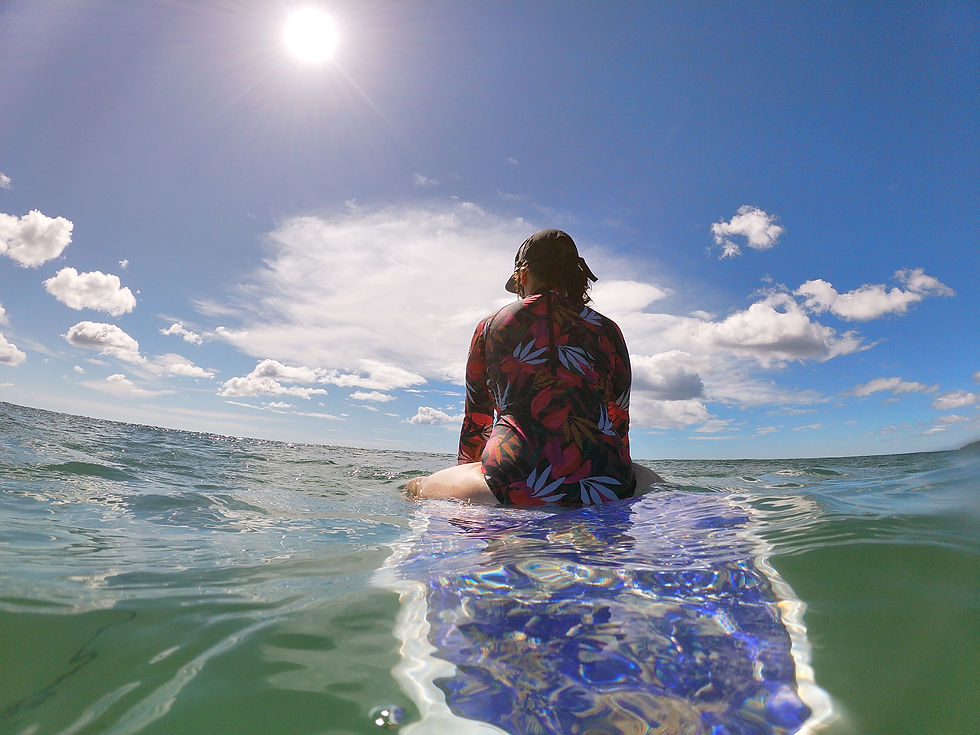
I do as I’m told, and make it out to the calm waters where we watch the setting sun and wait for the last green waves of the day. There is nothing in the world quite like the Pacific sunset, and no perspective more perfect than this. It is why when I return to the world, to the daily battle against casual and notatallcasual sexism, when I must next confront the things and people that mean to unseat and unsettle me, I will know what to do. This is just the whitewater. My eyes are on the horizon.


Comments